Park Ridge, IL · Garage Door Service
New Garage Door Installation for Rosemont's 1968-Era Homes
Most Rosemont houses went up around 1968 with lightweight steel doors and basic track hardware. Here's what a torsion-spring upgrade actually involves today.
- Repairs & new doors
- Springs & openers
- Serving 4 nearby communities
Stocked Parts
Rosemont sits about two miles from our Park Ridge shop, and the housing stock there runs close to the same build year we see across this part of the service area - median 1968, right in the middle of the 1938-1996 range for the broader region. Doors from that era were sized for openings that don't always match what's sold off the shelf now. Panel widths, track radius, and the rough framing around the opening were all built to specs that have shifted since.
We carry current steel sectional doors in the common widths and standard torsion springs rated for Chicago-area temperature swings - the climate here runs cold enough that spring steel and nylon rollers both see real stress across a winter. What we don't carry on the truck is anything custom: odd widths, insulated doors above the standard R-value lines, or specialty wood-look panels. Those get ordered ahead, and that's the one real limitation here - if your opening is non-standard, plan on a lead time rather than a same-visit swap.
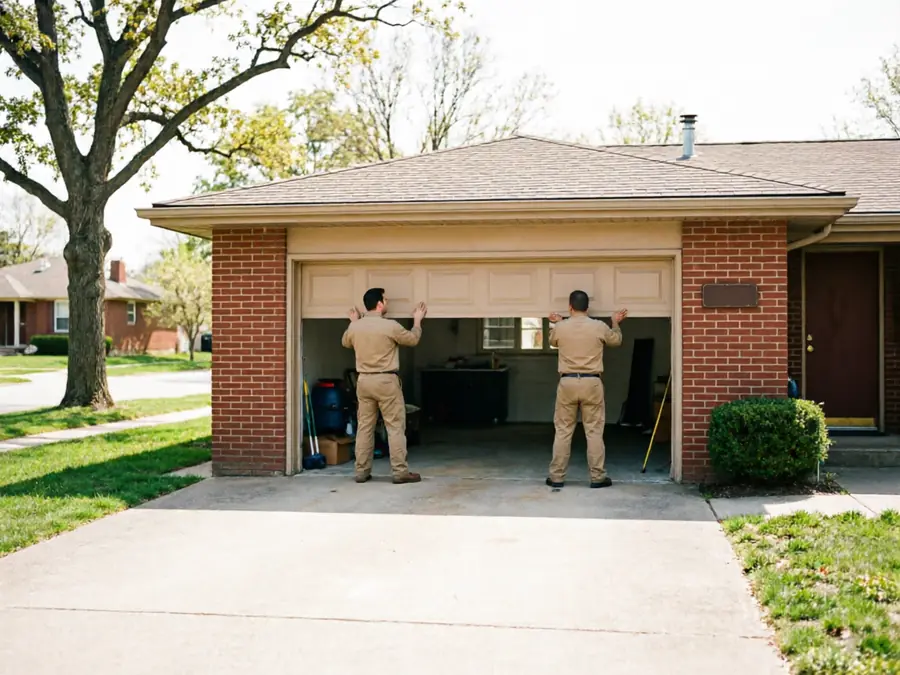
For straightforward replacements on a standard single or double opening, we bring what we need to finish in one trip.
What the Fix Involves
A full install on a house from the late 1960s usually starts with pulling the old track and hardware down to the jamb, because the mounting brackets from that period were set for a lighter door than what's sold today. New doors run heavier - more steel, more insulation - so the torsion spring has to be matched to the actual weight, not guessed at.
We set new vertical and horizontal track, mount a torsion spring sized to the door, and square the opening before the panels go up. On houses this age, the header above the door sometimes needs a reinforcing bracket added for the opener mount, since original framing wasn't always built with an opener's leverage in mind. That's a five-minute addition, not a structural job, but it's part of why these installs take a bit longer than a straight swap on newer construction.
Once the door's hung, we balance it - meaning the door should hold still at any point when lifted halfway by hand. If it doesn't, the spring tension's off, and that's adjusted before we call the job done.
Doing It Yourself
A torsion spring on a double door is under enough tension to break a wrist or worse if it's released wrong, and that risk doesn't change with age or confidence. We won't walk anyone through winding or unwinding one over the phone.
What's reasonable to do yourself: swatting on a new bottom weatherseal, replacing worn rollers one at a time with the door propped and the opener disconnected, or tightening loose hinge bolts. None of that touches the spring system.
If you're weighing a full replacement because the current door is original to a 1960s build, the honest math is usually in favor of swapping it rather than patching it - panel steel from that era doesn't match current gauges, and a cracked or dented section often can't be ordered to fit the rest of the door. At that point it's a full install, not a repair, and it's worth treating it as one from the start rather than paying twice.
Booking a Visit
We work out of Park Ridge and cover Rosemont as part of the regular route, about two miles out. There's no separate branch or local crew - the same truck and the same install standard apply here as they do a few streets over in Park Ridge itself.
Before we come out, measure your current opening width and height if you can, and note whether the opener is original or already replaced. That tells us whether we're pricing a straight door swap or a door-plus-opener job. Median household income in the area runs lower than some of the towns further out on this route, and we price the same hardware the same way regardless of address - the job is what it is.
If you're ready to get a number, check the Rosemont service page for what we cover day to day, or look at the main installation page for the full rundown on what a new door costs across this service area.
Frequently asked questions
Will a new door fit my original 1960s-era opening in Rosemont?
Most of the time, yes - standard single and double widths haven't changed much since the late 1960s. What sometimes needs adjusting is the track clearance or a header reinforcement for the opener mount, since framing from that period wasn't always built with a heavy opener in mind. We check this on site before ordering anything.
How far out does Park Ridge Garage Door Pros travel for Rosemont jobs?
Rosemont is about two miles from our Park Ridge location, so it's a short trip and a regular stop on the route. There's no separate Rosemont branch - the same crew and the same install process apply as anywhere else close in on the route.
Is it worth repairing an original door instead of replacing it?
Depends on the damage. A worn roller or a bent bottom panel can sometimes be fixed. But steel gauges from the 1960s and 70s don't always match what's sold now, so a cracked panel on an older door often can't be ordered to match - at that point replacement is the cheaper path long-term.
Book garage door service in Park Ridge
Call now or request a quote - tell us what the door is doing and where you are.