Park Ridge, IL · Garage Door Service
Broken Spring Repair for Niles, Illinois Homes
Spring repair for Niles homes built mostly in the 1960s, serviced from Park Ridge two miles away. Torsion hardware, cold-weather steel, and what actually breaks here.
- Repairs & new doors
- Springs & openers
- Serving 4 nearby communities
Why This Fails Locally
Niles sits two miles from our shop in Park Ridge, which means a call here doesn't involve guessing at a job sight unseen from across the metro - it's a short enough run that we're usually looking at the spring in person before the homeowner has finished describing the sound it made. That short drive matters less than what's attached to the house when we get there.
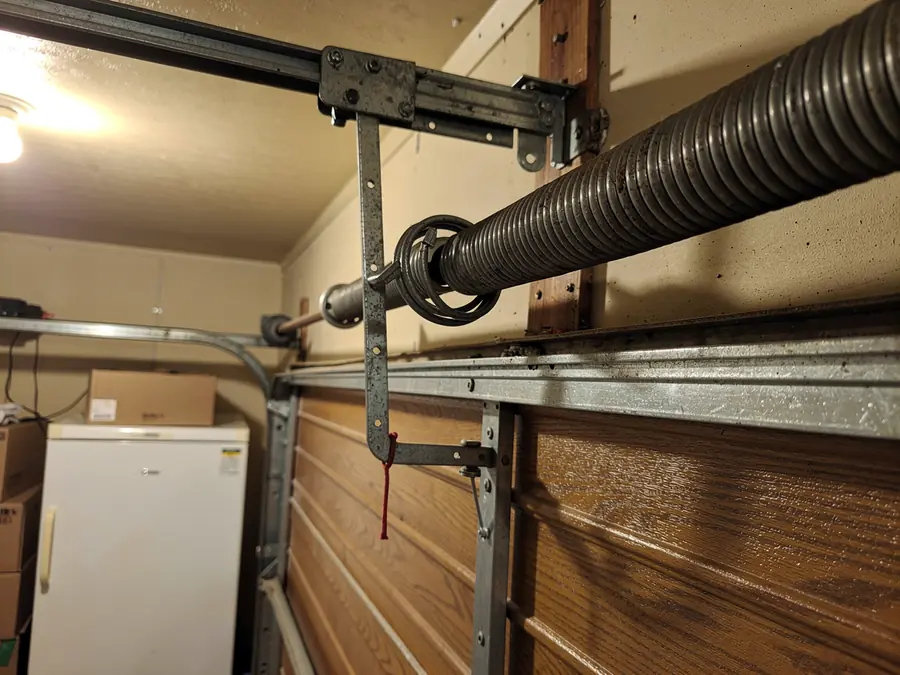
Most of Niles went up in the 1960s and 70s, with a median build year around 1965, which lines up with the broader pattern across this part of the service area: housing from 1938 to 1996, mostly clustered in that same two-decade stretch. Doors from that era were built for torsion spring hardware mounted on a single shaft above the opening, steel wound to a tension rating that assumed replacement every seven to ten years - not fifty-five. A lot of these springs have simply outlived the house they were installed in.
This region also sits in a cold climate band, and torsion springs lose tensile life faster when they cycle through hard freezes every winter. That's not a Niles-specific weather event - we don't have storm data to cite - but it's the climate this hardware has aged inside, year after year, for six decades.
Doing It Yourself
A torsion spring under tension can put someone in the hospital, and there's no honest way to write around that. The winding bars, the vise grips, the correct turns for the shaft diameter - get any of it wrong and the spring unwinds in a fraction of a second with enough force to break a hand or worse. We won't walk a homeowner through doing this themselves, and any guide that does is leaving out how often it goes wrong.
What a homeowner can safely check: whether it's one spring or two (most Niles doors from the 1960s and 70s run two on a double-wide door), whether the door is binding on the track rather than the spring itself, and whether the opener is trying to lift against dead weight - a telltale click-and-stop rather than a smooth pull.
If the door won't budge and there's visible gap in the coil where the spring sits, that's the spring. Call it in rather than force the door by hand; forcing a broken-spring door strains the opener motor and the cables both, and now it's two repairs instead of one.
Stocked Parts
Springs sized for the single-shaft torsion setups common on 1960s and 70s Niles doors are routine stock - this is the dominant hardware style across the 1938-1996 housing stretch that makes up most of this service area, so it's not a special-order part. What does occasionally run into a lead time is hardware for doors that were replaced once already with a mismatched spring from a prior repair - wrong wire gauge, wrong wind direction - which we see more in houses with a longer repair history than a newer build.
We carry standard torsion springs rated for typical door weights in this housing stock, plus the end bearings and center brackets that wear alongside them. What we don't stock on the truck is anything custom-wound for a non-standard door width - those get ordered, and that's the one honest delay we'll tell a homeowner about up front rather than promise a same-visit fix we can't back up.
The Symptom
The most common call out of Niles: the door won't lift, the opener motor runs, and nothing happens, or the door lurches up a few inches and drops back down. That's a broken torsion spring losing its grip on the shaft - the opener was never built to lift the full weight of a door on its own, only to assist a balanced spring system.
A second version: the door comes down hard and fast on its own, no opener involved, with a loud bang partway through the drop. That's usually the spring itself snapping, which on a 1960s-era single-shaft setup leaves the cable slack on one side and the door cocked slightly in the track.
Either way, the fix is the same - the spring gets replaced, not patched, and the opposite spring on a double-spring door usually gets looked at too, since if one has reached the end of its life the other from the same installation batch generally isn't far behind.
Where This Job Goes Sideways
The most common mistake on a 1960s-era Niles door is replacing one spring and leaving its partner alone. Two springs installed the same year, under the same tension, cycling through the same winters, wear out close together - swap one and leave the other, and the homeowner is back to a second call within a season.
The second mistake is sizing the replacement spring to the door's weight on paper rather than how it actually behaves on the track. A track that's slightly out of plumb, or rollers that have worn unevenly over fifty-plus years, changes how much lift a spring needs to deliver smoothly - the wrong wind or wire gauge on a door like this just sounds wrong rather than being flagged outright.
Income in this service area runs higher on average - the broader area median sits near $102,645 - than what Niles itself typically runs closer to, and that gap shows up in how people decide between a spring repair and a full door swap. On a door from the 1960s, a spring job is usually the right call for the money, and we'll say so plainly when it is.
Booking a Visit
We run this job out of Park Ridge, two miles from Niles, which keeps the window for a scheduled visit tight without us pretending to have a branch or a crew stationed in town - we don't, and we won't claim otherwise. What we can say is that the trip itself isn't the bottleneck; matching the right spring to a door that's likely original to a 1965-era build is the part that takes a trained eye, not a long drive.
For the rest of what we handle on Niles garage doors beyond spring repair, see the Niles service page. If you're calling from Park Ridge itself rather than Niles, the spring repair page for Park Ridge covers that service area's own numbers, which run a bit different from what we see here.
Frequently asked questions
How old does a Niles garage door spring usually get before it breaks?
Most Niles homes were built in the 1960s and 70s, median around 1965, and the torsion springs installed with those doors were rated for roughly seven to ten years of cycling. On a house that's never had the spring replaced, it's not unusual for the original to be decades past its rated life - that's often exactly why it finally lets go.
Do you have a branch in Niles?
No. We work out of Park Ridge, about two miles away, and travel to Niles for jobs. There's no separate depot or crew stationed in town, and we won't claim a response time we can't back up - we can tell you it's a short drive, not a guaranteed arrival window.
Is it ever cheaper to replace the whole door instead of just the spring?
On most 1960s-era Niles doors, a spring repair is the more sensible repair for the money - the door itself usually has life left in it. Replacement makes more sense when the track, panels, or opener are failing alongside the spring, not just the spring on its own.
Why does the opener run but the door won't lift?
That's the classic sign of a broken torsion spring. The opener motor was designed to assist a properly tensioned spring, not lift the full weight of the door by itself, so when the spring goes, the motor strains and the door barely moves, if at all.
Book garage door service in Park Ridge
Call now or request a quote - tell us what the door is doing and where you are.